
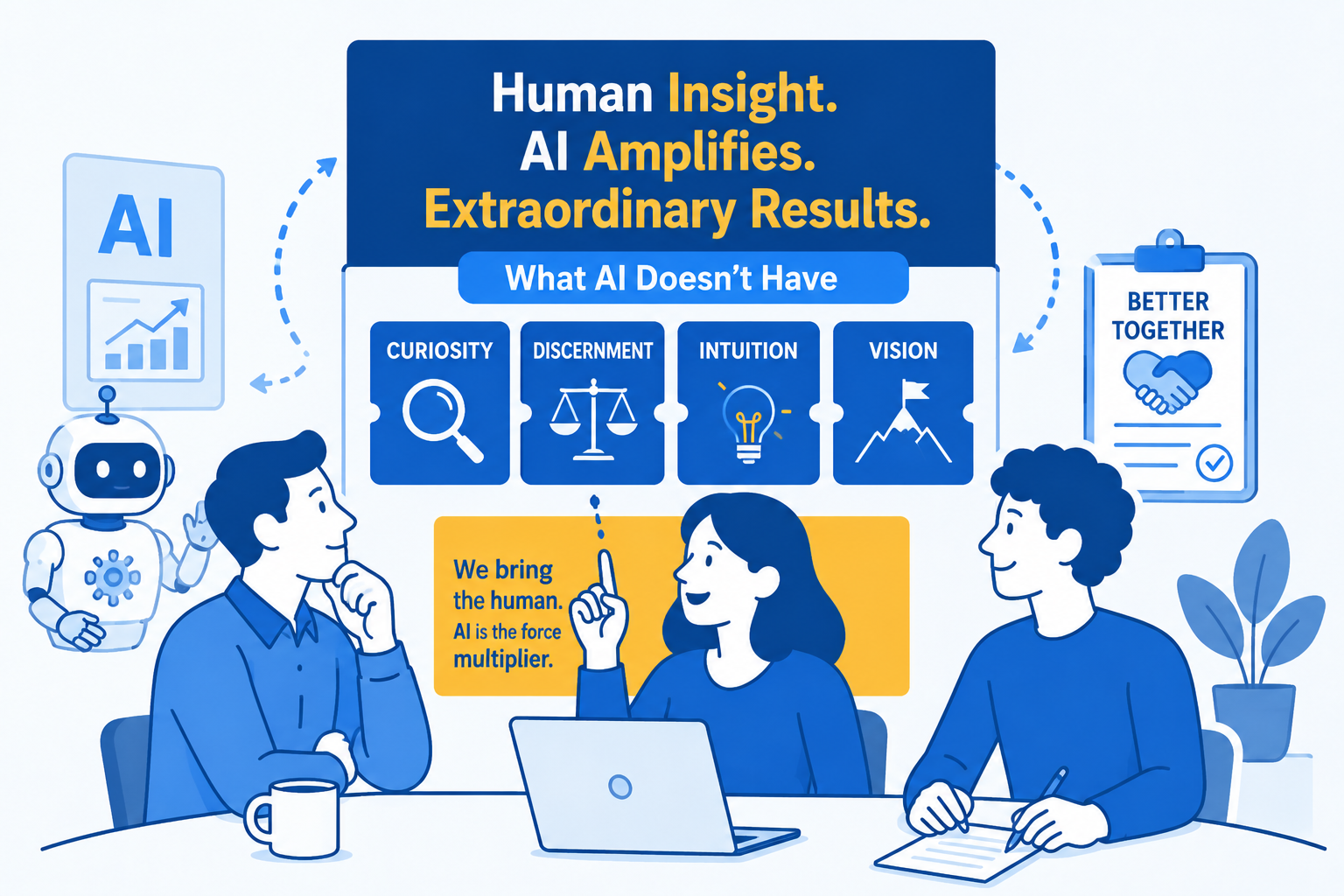
Everyone's talking about adopting AI. Use it for this, automate that, prompt your way to peak productivity. And honestly, they're not wrong. AI is genuinely incredible, and if you're not using it, you're making your job harder than it needs to be.
But here's the thing nobody's saying out loud: the biggest risk isn't that AI replaces you. It's that you let it.
The danger isn't automation. It's surrendering the thinking that makes you valuable in the first place.
Skills We Must Not Lose
The skill I'm most worried about people losing isn't writing. It isn't design. It isn't analysis. It's curiosity.
This post was actually sparked by a conversation with my colleague Alexis, who made a point that stuck with me: you can't just drop a prospect's website URL and a set of meeting notes into an AI tool and expect it to hand you a real understanding of their brand.
Who are they? What makes them different? What keeps them up at night? Getting that kind of insight requires someone who genuinely wants to know. Someone curious enough to push past the surface, pull back the layers, and ask questions that don't have obvious answers.
No prompt replicates that.
I fear that we'll treat curiosity like a nice-to-have when in reality, it's one of the most valuable skills we have. It's what helps us uncover opportunities, spot problems before they become crises, and understand what isn't immediately obvious.
And despite all the excitement around AI, curiosity is still a distinctly human advantage.
Here is that part that is actually worrisome:
If you stop doing the thinking, you stop developing the judgment. And judgment is the one thing AI can't hand you.
AI can give you options. It can summarize information. It can generate recommendations. It can even sound remarkably confident while doing it.
But judgment comes from experience. It comes from asking follow-up questions. It comes from being wrong, learning why, and adjusting. It comes from seeing patterns over time and understanding context that doesn't fit neatly into a prompt.
The more we outsource our thinking, the less we exercise the very muscles that help us make good decisions. It's like taking the escalator every day and wondering why climbing the stairs suddenly feels difficult.
AI Makes Average Faster
That's genuinely useful. It's also what makes this moment so interesting.
For years, producing competent work required a certain amount of effort and expertise. Today, almost anyone can create something reasonably good in a matter of minutes. When competence becomes easy, the differentiator isn't output. It's judgment.
The people who thrive won't necessarily be the ones who use AI the most. They'll be the ones who know when to challenge it, when to ignore it, and when to dig deeper than the first answer.
The skills that matter most are the ones that can't be prompted:
- The curiosity to notice what the data isn't saying
- The intuition to know a strategy is going to land wrong before it does
- The judgment to tell a client, "I hear you, but I don't think this is the right call"
- The determination to keep digging when the obvious answer is obviously wrong
None of those are in any product roadmap. I checked.
Use the Tools. Don't Become One.
This isn't an anti-AI take. Not even close.
I'm writing this after a day of using AI to diagnose a white screen of death on a client site, generate and edit images for a campaign, turn a stock image into an animated video featuring an actual colleague, pull insights from a ten-page analytics report, and rewrite a landing page headline seventeen times until it stopped being terrible. The technology is remarkable.
But the point was never the tool.
The tool is a force multiplier. And a multiplier only works if there's something worth multiplying. AI can help you move faster. It can help you write, analyze, summarize, organize, and execute.
What it can't do is replace your curiosity, your judgment, your intuition, or your willingness to challenge the obvious answer. Those aren't the skills becoming less valuable. They're becoming more valuable.
The question isn't whether you're using AI.
The question is whether you're still doing enough thinking to bring something worth multiplying.