
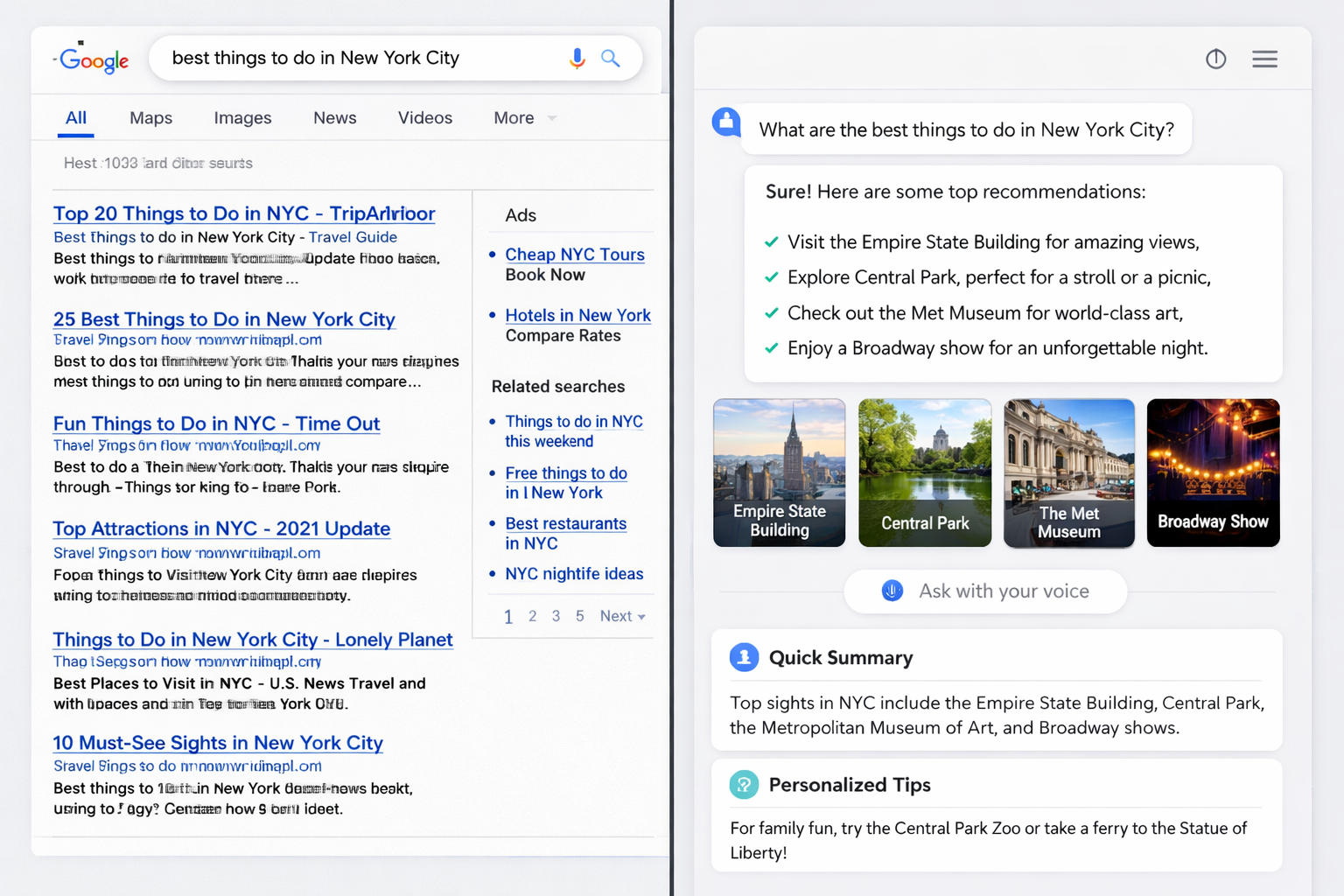
At this year’s Google I/O event, Google didn’t just announce new search features. They announced the end of an era.
The “10 blue links” model that defined SEO for more than two decades is being replaced by AI-generated answers, conversational interfaces, autonomous agents, and interactive search experiences. Google itself is calling this the biggest transformation to Search in over 25 years.
That matters because most businesses, agencies, and marketing teams are still measuring success like it’s 2018.
Traffic.
Rankings.
Clicks.
Sessions.
CTR.
Those metrics are becoming less representative of how people actually discover information online.
And as someone who has spent years in SEO and now increasingly works at the intersection of SEO, GEO, AI systems, and search behavior, I can say this clearly:
Search is no longer just about being found.
It’s about being referenced, trusted, synthesized, and surfaced by AI systems.
The companies that adapt early will win disproportionate visibility. The companies waiting for “proof” may find themselves invisible.
The Search Engine Is Becoming an Answer Engine
Google’s new AI-first search experience is designed to reduce friction between the question and the answer.
Instead of sending users through multiple websites to research a topic, Google increasingly wants to:
- Summarize information directly
- Generate conversational responses
- Perform tasks autonomously
- Keep users inside the Google ecosystem
- Deliver personalized AI experiences without requiring clicks
That means the traditional search funnel is collapsing.
Users no longer need to:
- Search
- Compare results
- Open multiple tabs
- Read several articles
- Decide on an answer
AI is compressing those steps into a single interaction. Google’s “AI Mode” and intelligent search interfaces are specifically designed to eliminate the need for traditional browsing behavior. For publishers and businesses, that creates a difficult but unavoidable reality:
Your content may influence the answer without ever earning the click.
The Old Measurement Model Is Breaking
 This is the conversation agencies need to start having with clients immediately. Because many businesses are about to experience something confusing:
They may maintain visibility and influence even as traffic declines.
That sounds contradictory, but it isn’t.
In AI-driven search:
- Your brand can appear in summaries
- Your expertise can shape AI-generated answers
- Your products can be recommended
- Your research can be cited
- Your reputation can influence AI outputs
…without the user ever visiting your website.
Traditional analytics platforms were not built for this.
If a user asks:
“Who are the best industrial mixer manufacturers for food processing?”
And Google’s AI Overview summarizes five companies, cites two sources, and the user makes a decision without clicking; the influence happened even though the session never did.
That is why rankings and traffic alone are becoming an incomplete set of KPIs.
Not useless.
Incomplete.
Welcome to the Era of Visibility Without Clicks
This shift has already started.
Google AI Overviews have expanded aggressively, and research shows they frequently surface sources differently than traditional rankings. In many cases, cited sources do not even appear prominently in organic search results.
That changes the entire optimization strategy.
Historically, SEO focused on:
- Ranking pages
- Increasing clicks
- Driving sessions
- Improving CTR
Now we also need to optimize for:
- AI citation likelihood
- Entity recognition
- Brand authority
- Structured expertise
- Semantic clarity
- Multi-platform presence
- Trust signals
- Machine readability
- Knowledge graph alignment
This is where GEO (Generative Engine Optimization) becomes critical.
Not because SEO is dead.
But because search behavior has fundamentally changed.
AI Search Rewards Authority, Not Just Keywords
For years, many SEO campaigns succeeded by targeting keywords with the right combination of:
- Search volume
- backlinks
- technical optimization
- topical relevance
That still matters.
But AI systems evaluate information differently from traditional ranking algorithms.
Large language models and AI search systems increasingly rely on:
- contextual understanding
- corroborated expertise
- consistent brand mentions
- authoritative references
- multi-source validation
- entity relationships
- topical trust
In other words, AI engines are trying to determine who should be trusted, not just who best targeted a phrase.
That is a massive strategic shift.
Why This Changes Agency-Client Conversations
Many agencies will struggle with this transition because they built reporting models around traffic growth.
Clients have also been conditioned to think:
“More traffic = better marketing.”
But in AI search, visibility may become partially disconnected from visits.
That means agencies need to evolve from:
“We increased your sessions by 18%...”
...to conversations like:
- “Your brand is being surfaced in AI answers.”
- “Your expertise is influencing recommendation systems.”
- “Your content is training discovery pathways.”
- “Your company is appearing in conversational search.”
- “Your authority footprint is growing across AI ecosystems.”
This requires more sophisticated reporting.
And honestly, many businesses are not ready for that yet.
The Future Belongs to Search Ecosystems, Not Just Google
Another mistake businesses are making is assuming this is only about Google.
It isn’t.
Discovery is fragmenting rapidly across:
- ChatGPT
- Gemini
- Perplexity
- Claude
- YouTube
- TikTok
- AI agents
- voice assistants
- proprietary enterprise copilots
Even Google itself is increasingly incorporating forum discussions, creator content, and conversational sources into search experiences.
That means brands need visibility across the broader information ecosystem, not just traditional SERPs.
This is why modern search strategy is becoming:
- cross-platform
- entity-driven
- reputation-centric
- AI-aware
- multimodal
The companies that are still treating SEO as a standalone channel are already behind.
What Businesses Should Actually Do Right Now
The answer is not: panic.
And it’s definitely not: abandon SEO.
The answer is: evolve your strategy.
Businesses should be:
- Building deeper topical authority
- Creating genuinely useful expert content
- Strengthening brand entities
- Improving structured data
- Expanding multi-platform presence
- Investing in original insights and research
- Developing content AI systems can confidently reference
- Monitoring AI search visibility, not just rankings
Most importantly, companies need to stop asking:
“How do we rank?”
And start asking:
“How do we become the trusted source AI systems reference?”
That is the new game.
Final Thought
Google Search is not disappearing.
But the version of search that was built over the last 20 years, around absolutely is.
We are moving from an internet built around clicks to an internet built around trusted answers.
From rankings to references.
From pages to entities.
From traffic to influence.
The agencies and brands that recognize this early will help shape what visibility means in the AI era.
Everyone else will still be celebrating rankings while their actual discoverability slowly disappears.