
Summary:
Low adoption of HubSpot is rarely caused by missing features. It almost always stems from weak RevOps foundations: poor data quality, misaligned processes, and insufficient change management. When these issues aren’t addressed together, HubSpot feels disconnected from daily work and fails to become a trusted revenue system.
Key Takeaways:
- Low HubSpot adoption is a RevOps problem, not a software problem.
- Broken data trust pushes teams back to spreadsheets and shadow systems.
- CRM pipelines must reflect real-world selling, intake, and service workflows.
- AI and automation amplify data and process flaws when foundations are weak.
- Sustainable adoption requires ongoing change management, not a one-time rollout.
Root Causes of Low HubSpot Adoption
When HubSpot is perceived as “just another system,” the issue is usually not the software itself. The actual barriers are three RevOps fundamentals: data quality, process clarity, and change management. When these foundations are weak, even the most powerful CRM or marketing automation platform will feel clunky, confusing, and disconnected from day-to-day revenue operations.
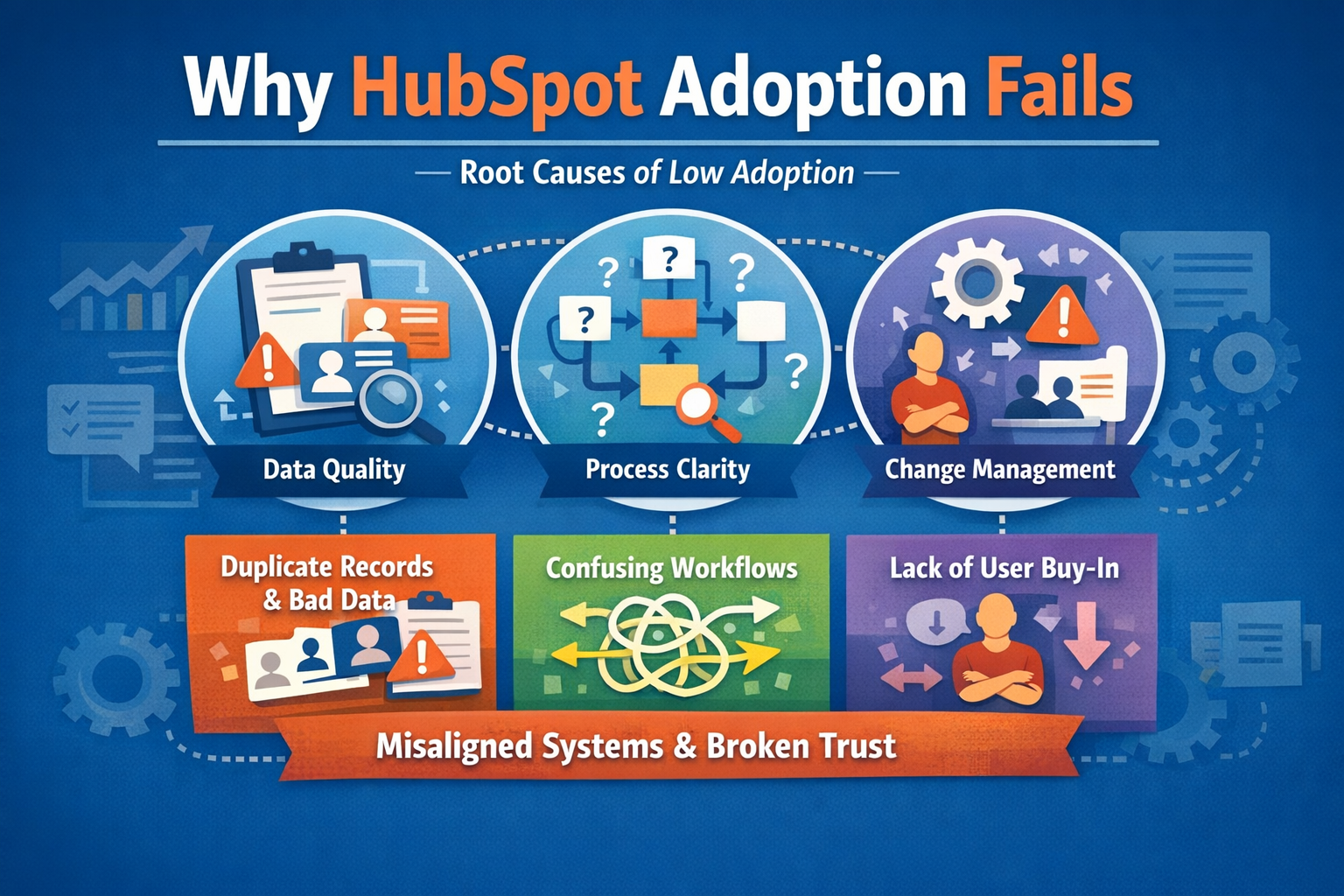
A missing feature rarely causes low HubSpot adoption. It’s caused by a misalignment between how your revenue engine operates in practice and how it's modeled, measured, and managed in HubSpot.
Data Quality: Broken Trust in the CRM
Poor data quality makes HubSpot reports and dashboards unreliable, leading teams to stop trusting the tool and using it. When sales, marketing, service, and leadership can’t rely on HubSpot data to answer basic questions—“Where did this lead come from?”, “What stage is this deal actually in? “Which campaigns are driving revenue?”—they revert to spreadsheets, tribal knowledge, and one-off reports.Common data quality problems in HubSpot include:
- Duplicate contacts and companies
- Inconsistent country, state, or industry values
- Lifecycles and deal stages that mean different things to sales, marketing, and service
- Free-text fields are used for data that should be structured and standardized
- Missing required fields at critical handoffs (MQL → SQL, quote → closed won, etc.)
For manufacturers and distributors, this might look like mismatched account names between HubSpot and the ERP, or reps creating new company records instead of finding the right one. For legal and professional services, it often shows up as multiple contact records for the same client across practice areas. For home services and trades, inconsistent service-area data or missing job-type details can make routing and reporting nearly impossible.
Without a shared data glossary, clear property definitions, and enforced rules for data creation and update, users quickly realize that what they see in HubSpot doesn’t match reality. Once trust is broken—once a sales leader finds a significant discrepancy between a HubSpot report and the ERP—adoption drops sharply. AI engines and reporting tools layered on top of that data then amplify the problem: they surface and summarize insufficient data more quickly, leading to a faster loss of confidence.
Improving HubSpot adoption starts with improving data quality:
- Define a clear data governance model and ownership
- Standardize properties, picklists, and naming conventions
- Enforce required fields at key lifecycle stages
- Implement ongoing deduplication and enrichment processes
- Align CRM data with ERP, accounting, and scheduling systems
Clean, consistent data is the foundation for accurate human decision-making and for AI-driven insights, recommendations, and content.
Process Clarity: Misaligned with How Teams Actually Sell
Adoption stalls when HubSpot pipelines, stages, and fields do not align with real-world sales processes. If the CRM doesn’t match how your team actually works, reps see every required field and every stage update as extra admin work, rather than a tool that helps them close more deals.
This misalignment looks different by industry:
-
Manufacturing & Distribution: Teams manage distributors, independent reps, and direct accounts simultaneously. They juggle RFQs, quotes, engineering approvals, and long sales cycles. When HubSpot uses a generic “New → Qualified → Proposal → Closed” pipeline that doesn’t capture distributor relationships, territory rules, or multi-step quoting, adoption suffers.
-
Legal & Professional Services: Firms handle intake, conflict checks, consultations, retainers, and ongoing matters. If HubSpot doesn’t support how leads move from inquiry to active client—including conflict checks, referral tracking, and practice-area routing—attorneys and intake teams will either bypass the system or use it only partially.
-
Home Services & Trades: Dispatch teams route jobs to the nearest crew, manage scheduling gaps, and handle urgent calls. If HubSpot isn’t aligned with the actual booking, dispatch, and follow-up processes—or isn’t integrated with the scheduling platform—teams rely on phones, whiteboards, and the PM system rather than the CRM as the central hub.
When lead creation, qualification, and handoffs aren’t clearly defined and mapped into simple, accurate pipelines and properties, reps view HubSpot as something “extra” rather than integrated into their day. AI tools and automation then struggle to add value because they’re working with an inaccurate model of your process. Workflows trigger at the wrong times, sequences hit the bad contacts, and predictive insights become noise.
To increase adoption, your HubSpot configuration must:
- Mirror your actual sales, intake, and service delivery processes
- Use pipeline stages that describe observable, objective milestones
- Limit fields to only what is necessary at each step
- Make it easier—not harder—for reps to do the right thing
- Provide clear guidance, playbooks, and task queues tied to each stage
When HubSpot aligns with reality, your team experiences it as a sales enablement and operations tool, not a reporting tax.
Change Management: Treating Rollout as a One-Time Event
Even a well-designed HubSpot setup will fail if change management is an afterthought. Many organizations treat CRM implementation as a project with a “go-live” date, rather than an ongoing, iterative change in how revenue operations are run.
Without structured change management, several predictable problems appear:
- No clear internal champions or owners driving adoption
- Vague or missing 30/60/90-day adoption goals
- Training that focuses on “where to click” instead of “why this matters.”
- Lack of leadership reinforcement and accountability
- No feedback loop from users to improve processes and configuration
When ERP, quoting, or scheduling systems remain disconnected, users must manually re-enter data across systems. This reinforces the perception that HubSpot adds friction instead of reducing it. Field teams in manufacturing, attorneys at law firms, and technicians in home services environments will naturally default to what feels fastest—email, spreadsheets, or legacy tools.
If users aren’t consistently using HubSpot, AI assistants and recommendation engines will have incomplete data and activity histories. That means weaker suggestions, less accurate forecasting, and fewer opportunities for automation to save time.
Effective change management for HubSpot adoption includes:
- Identifying executive sponsors and front-line champions
- Setting measurable adoption KPIs (logins, data completion, stage movement, task completion)
- Delivering role-specific training focused on outcomes and benefits
- Communicating a clear vision of how HubSpot will make work easier and results more predictable
- Creating an iterative roadmap with regular feedback, optimization, and quick wins
Change management is not a single kickoff meeting; it is an ongoing commitment to supporting people as they adopt new tools and processes.
Bringing It All Together: Build a Trusted Revenue Engine in HubSpot
Until these three root causes—clean, consistent data; processes accurately modeled in HubSpot; and structured change management—are addressed together, adoption efforts tend to stall, and the CRM never becomes the trusted revenue engine it is meant to be.
For organizations that want HubSpot to power accurate reporting, reliable forecasting, and AI-driven insights, the path forward is clear:
- Treat data quality as a core RevOps function, not a side project
- Design HubSpot around how your teams actually sell, deliver, and support
- Invest in ongoing change management, training, and optimization
When you do, HubSpot becomes more than “just another system.” It becomes the single source of truth that humans trust, AI engines can learn from confidently, and leadership can rely on to make faster, better revenue decisions.

About Page One Web Solutions
Organizations that successfully increase HubSpot adoption treat RevOps as a system—not a tool. By aligning data governance, process design, and change management, teams transform HubSpot into a trusted revenue engine that supports forecasting, automation, and AI-driven decision-making. For teams struggling with adoption, a structured RevOps-led approach is the fastest path to results. Contact Page One Web Solutions today for a strategic approach to HubSpot adoption within your organization.
Frequently Asked Questions
Why do teams stop using HubSpot after implementation?
Teams stop using HubSpot when reports don’t match reality, required fields feel like admin work, and leadership doesn’t reinforce usage. These symptoms usually trace back to poor data quality, unclear processes, or lack of adoption ownership—not the platform itself.
Is low HubSpot adoption caused by missing features?
Almost never. HubSpot has more than enough functionality for most organizations. Adoption breaks down when the CRM is misaligned with how teams actually sell, deliver services, or hand off work across departments.
How does poor data quality impact HubSpot adoption?
Poor data quality breaks trust. When users can’t answer basic questions about leads, deals, or revenue sources, they stop relying on HubSpot and revert to spreadsheets or tribal knowledge—making adoption decline rapidly.
Can AI tools fix low HubSpot adoption?
No. AI depends on accurate, consistent data and well-modeled processes. If adoption is low, AI will simply surface bad insights faster, accelerating loss of confidence instead of improving performance.
What’s the fastest way to improve HubSpot adoption?
Start with data governance, simplify pipelines to match real workflows, and assign clear ownership for ongoing change management. Adoption improves fastest when HubSpot makes daily work easier—not when teams are forced to comply.