
Why Does Your Marketing Data Look Good But Still Feel Unclear?
Let’s start with a familiar scene.
Your marketing dashboard says things are working. Traffic is up. Leads are coming in. There are charts. There are arrows pointing upward. Everyone feels… cautiously optimistic.
Then someone asks, “So what’s our actual cost per customer?”
And suddenly, the room gets a little quieter.
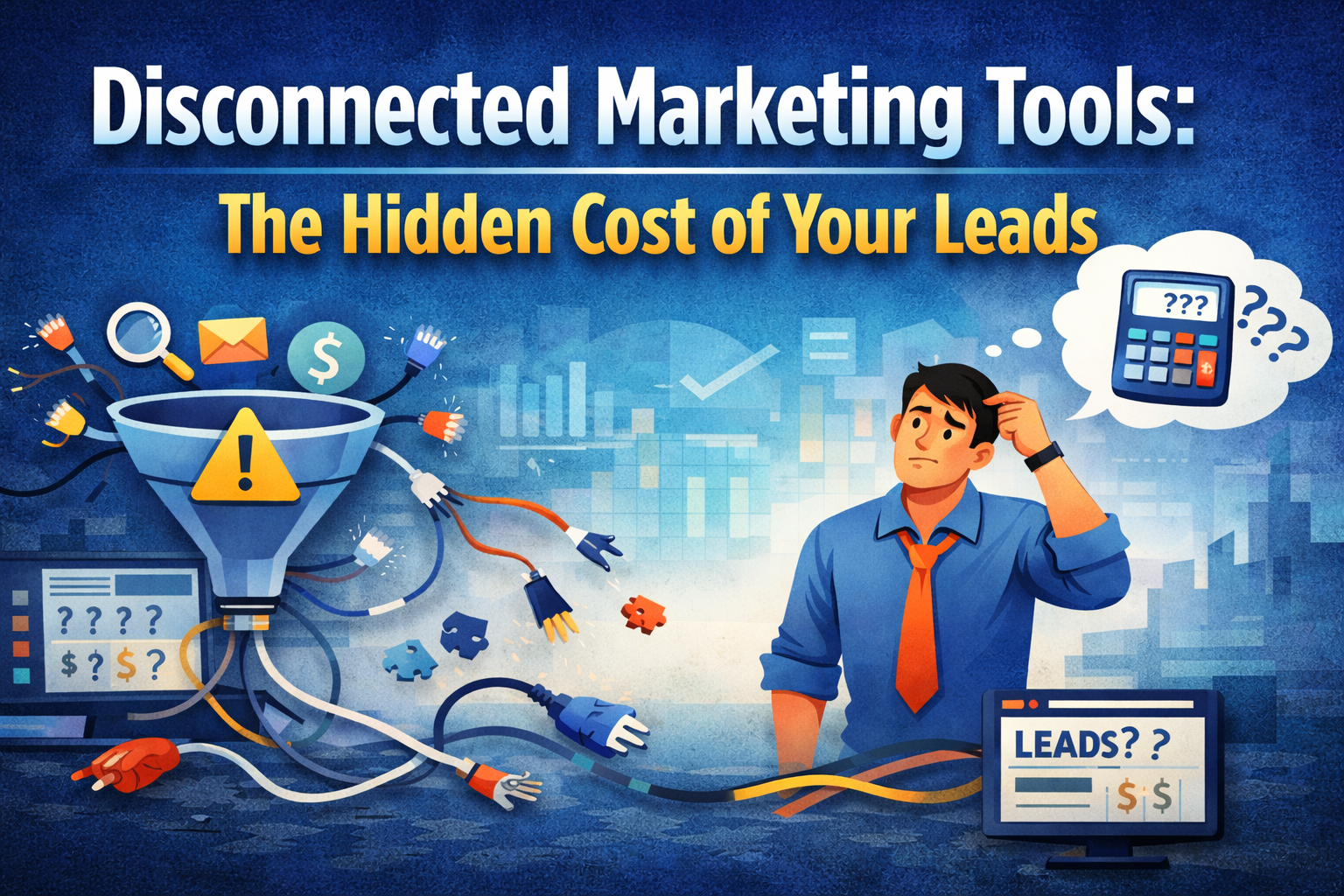
Not because the answer doesn’t exist, but because it lives in five different systems, two spreadsheets, and one person’s memory.
This isn’t a marketing failure. It’s a visibility problem.
When your marketing platforms, analytics tools, and sales systems aren’t connected, you lose the ability to measure what actually matters. Cost per lead. Cost per qualified lead. Cost per customer.
How Do Disconnected Marketing Tools Create Reporting Blind Spots?
Most companies don’t have a tool problem. They have a connection problem.
You might be using:
- Website forms to capture leads
- Email platforms to track engagement
- Google Ads or LinkedIn for paid campaigns
- Call tracking software for phone leads
- A CRM for sales
All of these tools are doing their job. Just not together.
When they aren’t connected, data becomes fragmented. Attribution becomes inconsistent. And your reporting starts to feel like a group project where nobody talked to each other.
Marketing teams end up relying on:
- Manual reporting
- Partial analytics
- Inconsistent lead source data
- “Best guess” performance insights
Eventually, you need to answer real questions:
- Which campaigns are driving qualified leads?
- Which channels are producing revenue?
- What is our actual cost per customer?
And that’s where things break down.
How Does CRM Attribution Help You Track the Full Buyer Journey?
When your systems are connected through your CRM, everything changes.
Instead of guessing, you can track:
- First interaction with your brand
- Lead source
- Sales qualification
- Opportunity creation
- Closed revenue
Even if your tech stack isn’t perfect, consistent source tracking inside a CRM like HubSpot gives you real visibility.
Now you can measure:
- Cost per lead
- Cost per qualified lead
- Cost per opportunity
- Cost per customer
And this is where marketing shifts from activity to outcomes.
What Problems Does Marketing Attribution Actually Reveal?
Attribution doesn’t just measure marketing performance. It exposes what’s happening across your entire revenue process.
It often reveals:
- Leads that were never contacted
- Slow follow-up times
- Unclear qualification criteria
- Misaligned targeting
- Poor lead routing
These aren’t just marketing issues. They’re revenue operations issues.
Attribution acts as a diagnostic tool, showing you where leads are being lost and where performance can be improved.
How Can Better Attribution Reduce Cost Per Qualified Lead?
In 2025, we worked with a water damage restoration company on its inbound marketing campaigns.
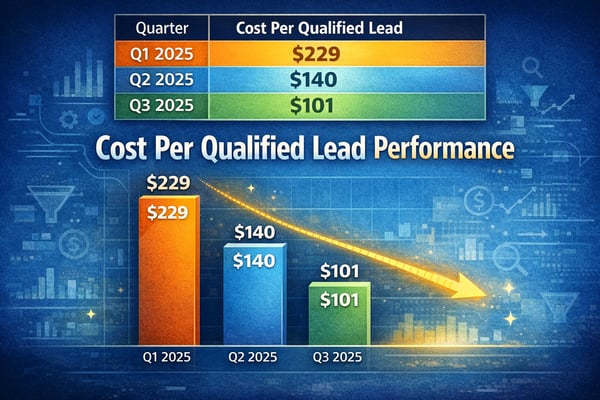
Their systems were connected enough to track lead sources, qualification outcomes, and campaign costs through their CRM.
That visibility led to measurable improvements.
What Changed
Marketing improvements:
- Refined targeting
- Optimized ad spend
- Improved landing page performance
Sales improvements:
- Clearer qualification standards
- Faster follow-up
- Better lead routing
The result was a 56% reduction in cost per qualified lead within six months.
How Does Your Cost Per Lead Compare to Industry Benchmarks?
A provider called 33 Mile reported that agency-generated leads can cost around $775 per lead, not including qualification.
Even in Q1, the cost per qualified lead was significantly lower. By Q3, the gap widened further.
How Do You Turn Inbound Marketing Into a Revenue Engine?
Inbound marketing works best when it’s connected to the full revenue system.
That requires:
- Consistent attribution data
- Marketing and sales alignment
- Clear qualification criteria
- Pipeline visibility
When those elements are in place, you can:
- Identify where leads drop off
- Improve conversion rates
- Optimize campaigns based on revenue
- Scale with confidence
What Is the Real Impact of Connecting Your Marketing and Sales Data?
Disconnected tools don’t just make reporting harder. They hide what’s really happening. Without attribution, you can’t measure performance accurately or identify gaps in your funnel. When your data is connected inside a CRM like HubSpot, attribution becomes more than reporting. It becomes a system for growth.
At Page One Web Solutions, we help companies connect their tools, align their teams, and build a clearer path from marketing to revenue.
Frequently Asked Questions About Marketing Attribution
What is marketing attribution?
Marketing attribution tracks how leads and customers interact with your marketing channels before converting, helping you understand what drives revenue.
What is cost per qualified lead?
Cost per qualified lead measures how much you spend to acquire leads that meet your sales criteria, making it more meaningful than cost per lead alone.
Why is a CRM important for attribution?
A CRM like HubSpot connects marketing and sales data, allowing you to track the full buyer journey and accurately measure ROI.
What happens if marketing tools are disconnected?
Disconnected tools create incomplete data, making it difficult to measure performance, optimize campaigns, or understand true ROI.
How can I improve attribution in my business?
Start by centralizing data in your CRM, standardizing lead source tracking, and aligning marketing and sales processes.