
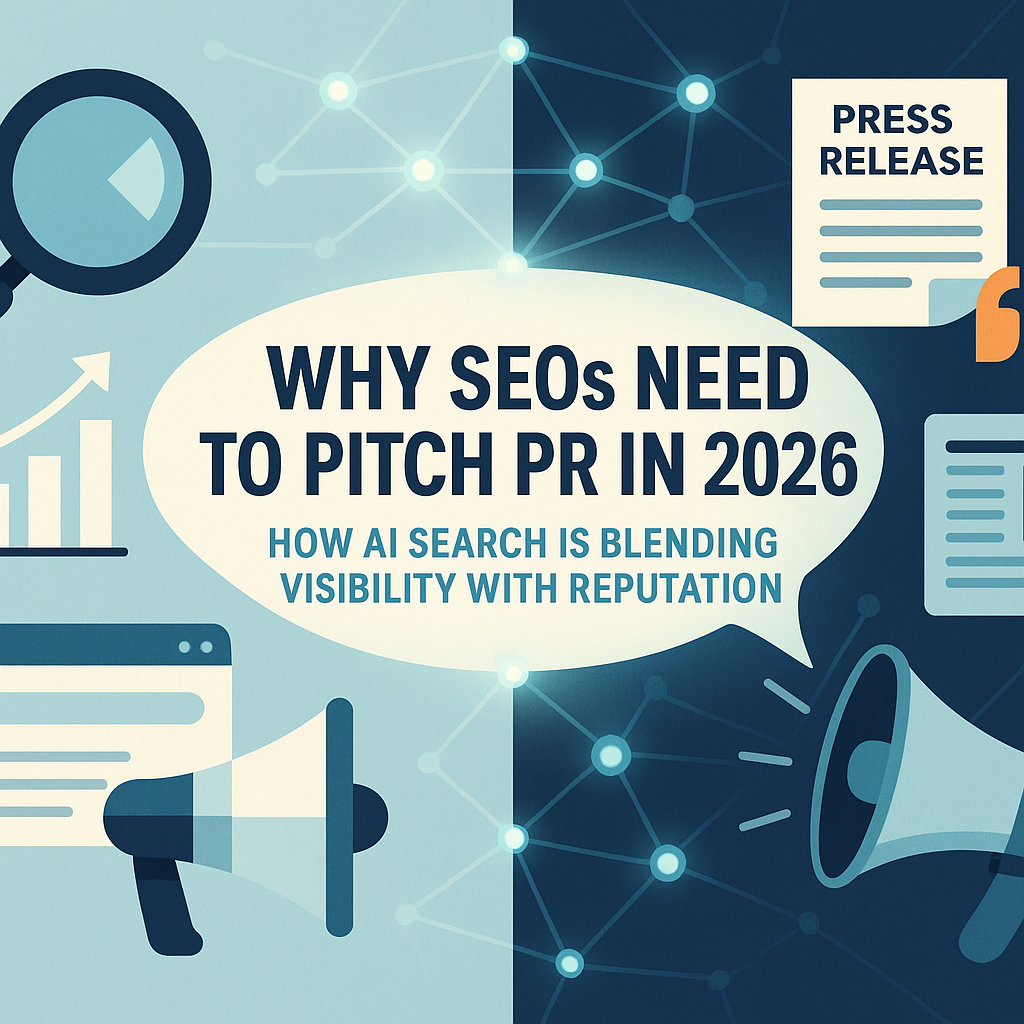
AI search has fundamentally reshaped how brands gain visibility, elevating PR, social narrative-building, and earned media as core SEO levers. In 2026, SEOs must begin to think like publicists: shaping perception, earning mentions, and feeding AI models consistent, credible signals. The brands that combine SEO rigor with PR storytelling will dominate AI-driven discovery.
If you’ve been in SEO long enough, you’ve witnessed at least three different eras of existential dread: the “links are everything” era, the “content is king” era, and now the “wait, what do you mean AI isn’t showing my site at all?” era.
Welcome to (almost) 2026, where SEO and PR have officially entered their “it’s complicated” relationship phase. You, dear SEO, are now expected to be part optimization specialist, part publicist, part brand therapist.
The truth is, AI search has changed the playing field, and traditional SEO tactics alone aren’t enough anymore. Visibility is no longer just an algorithmic problem; it’s a reputation problem. A narrative problem. A “what does the internet collectively think about you?” problem.
So let’s talk about why adopting a PR mentality is a smart move for SEOs in 2026.
1. Digital PR Mentions Are the New “Trust Flow” for LLMs
Links still matter. Mentions still matter. But how they matter has shifted.
Large Language Models don’t behave like crawlers; they behave like researchers with infinite coffee and an infinite number of tabs open (shout-out to all my tabaholics!). When an LLM answers a question about your industry, it’s pulling from patterns, sentiment, and authority signals across the public web. That includes:
- Trade publications
- Niche blogs
- Industry influencers
- Earned media
- Brand stories and interviews
In other words, Digital PR is a ranking factor in AI Search.
Positive mentions help shape:
- How often your brand is cited
- How positively your brand is framed
- Whether your brand is included as an example or excluded entirely
- What proof points AI uses to describe your brand
In a recent Search Engine Journal article, they explain that digital PR now has dual value: earning authority for traditional SEO while shaping how LLMs interpret your brand’s credibility.
If SEOs used to chase backlinks, think of AI search as chasing perception links. And the more high-quality publications and voices you show up in, the more “receipts” you give AI models to work with.
2. Social Media Is Your Owned PR Channel—Not Just a Megaphone
AI search visibility isn’t just shaped by big media sites—it’s shaped by social ecosystems.
Your social content is no longer just “engagement fodder.” It’s becoming part of the signal set that informs:
- What topics your brand is associated with
- How people talk about your brand
- Whether your brand shows up in sentiment-driven AI summaries
- How future consumers (especially younger ones) learn about your brand
And let’s be clear: younger audiences are not learning about brands via homepages; they’re learning through short-form storytelling.
SproutSocial said it best:
“Brands should focus on rich storytelling, character-building and creator collaborations that reflect real experience; that way, users see themselves in the content and connect deeply with it.”
In 2026, social media isn’t a distribution channel - it’s your owned PR engine, one that feeds:
- Brand perception
- Narrative consistency
- Authority reinforcement
- AI training data
If your social presence is quiet… your AI presence will be too.
3. PR, Like SEO, Is a Long Game (And You Do Have Things Worth Saying)
SEOs love repeatable frameworks. PR loves messy humans telling compelling stories.
But here’s the bridge: both are long-term, cumulative reputation plays. And both suffer when brands underestimate what they have to share.
You don’t need:
- A product launch
- A new hire
- A new location
- A company holiday photo shoot (though that never hurts)
You do need to show up with something meaningful to say.
Think:
- Reactions to industry changes
- POVs on controversial shifts
- Predictions rooted in experience
- A “state of the industry” mini-report
- Stories illustrating why your approach is different
- An educational angle only your team could offer
These pieces build a breadcrumb trail of credibility, not just for people, but for AI systems learning who you are and what you stand for.
Paula Stanton, Vice President of Client Services at Broadreach Public Relations in Portland, Maine explains that small but consistent stories help build long-term authority. "You don't need major news to have something newsworthy. In fact, small, regular stories position you as an active participant in your community and industry more than large but infrequent stories. Over time, this steady drumbeat builds credibility and ensures that when AI models or journalists need an expert perspective in your space, your name surfaces because you've been reliably contributing to the discourse. Your expertise, a fun company tradition or a unique partnership are all examples of potential stories to share."
If SEO is about being discovered, PR is about being understood. And AI needs both.
4. PR Mentions Are Literally Training Data
Google’s AI Overviews, OpenAI’s fan-out reasoning, Anthropic’s constitutional learning… they all rely on publicly available content for training and inference. Which means:
Your PR stories?
Your earned mentions?
Your thought-leadership articles?
Your media coverage?
All of it becomes part of the “collective knowledge” AI models draw from.
Search Engine Land writes that PR is becoming essential for AI visibility precisely because earned media is disproportionately represented in models’ source ecosystems.
AI isn’t just indexing your coverage—it’s internalizing it.
Which means the more your brand shows up in authoritative, neutral-to-positive coverage, the more likely AI is to:
- Reference yor brand
- Recommend your brand
- Include your products/services in summaries
- Rank your barnd as a top option in AI answers
This is PR as visibility influence, not manipulation, but contribution. You are giving AI a reason to remember your brand.
5. Humans Might Doubt PR Articles—But AI Doesn’t
Here’s the twist: People tend to treat PR as “maybe biased.” AI does not.
LLMs evaluate content in aggregate. They look for:
- Frequency
- Consistency
- Sentiment
- Relevance
- Credible sourcing
So while a human reader might roll their eyes at a good old-fashioned press release, AI sees a citation with weight.
On a thread I found on Reddit, PR pros are now openly acknowledging that PR might matter more in the AI era than ever before because it signals legitimacy to machines that don’t judge tone, only patterns.
This means that if your competitors are investing in PR and you aren’t, AI may assume they’re the bigger authority, regardless of who actually is. (Ouch!)
You can be the best in your industry, but if the internet hasn’t said it… AI won’t either.
So… What Should SEOs Do About This?
Think of 2026 SEO as a Venn diagram where Search, Brand, and Reputation overlap. PR is no longer in a separate circle; it sits at the center.
Here’s your starter playbook:
✔ Build a monthly or quarterly digital PR hit-list
Trade publications, creator partnerships, niche blogs, micro-influencers.
✔ Develop a repeatable thought-leadership engine
Short POVs, timely reactions, industry analyses.
✔ Treat social as a PR storytelling platform
Not a post-it-and-ghost-it channel.
✔ Measure mentions the way you’d measure backlinks
Frequency, sentiment, authority, and theme clusters.
✔ Reposition PR as “AI Visibility Insurance”
It strengthens every part of your digital footprint.
SEOs Who Embrace PR Will Win the AI Search Era
AI is rewriting the rules of discoverability, and PR is emerging as one of the strongest ways to shape how LLMs interpret your brand across the web.
Thought leadership, press coverage, and brand mentions no longer influence only human perception; they shape how AI sees your brand, defines it, and recommends it.
In 2026, the best SEOs won’t just optimize pages.
They’ll curate narratives.
Shape perception.
Earn attention.
And ultimately, make sure AI models have the “receipts” they need to include your brand in the conversation.

Page One Web Solutions helps strengthen its clients' brand authority through search, storytelling, and reputation-building. Page One helps brands integrate SEO, AI visibility strategies, and modern digital PR to ensure they show up consistently across human searchers and machine-generated answers. If your team wants to future-proof visibility in the AI era, we offer strategy, implementation, and ongoing optimization tailored to 2026 and beyond.
Frequently Asked Questions
1. Why does PR matter more for SEO in 2026?
Because AI search models rely heavily on public sentiment, earned media, and narrative consistency—not just backlinks—to determine which brands appear in generative answers. PR provides the authoritative mentions and perception signals AI depends on.
2. How do digital PR mentions influence LLM rankings?
LLMs evaluate how often a brand is mentioned, how positively it's framed, and what sources validate it. High-quality PR hits function like “credibility receipts,” shaping how AI interprets your authority and expertise.
3. Does social media really impact AI search visibility?
Yes. Social content is now part of AI’s training and inference data. Short-form storytelling, brand POVs, and audience reactions inform what topics your brand becomes associated with in AI summaries.
4. What types of stories should brands share to improve AI visibility?
Industry reactions, expert predictions, POV pieces, mini-reports, and differentiated insights—anything that builds a consistent knowledge trail about your expertise. AI needs narrative signals, not just metadata.
5. Is PR still valuable if my industry is niche?
Absolutely. Niche publications and micro-influencers often carry outsized authority in AI training ecosystems. Smaller, specialized mentions can significantly enhance perceived expertise within specific topic domains.