
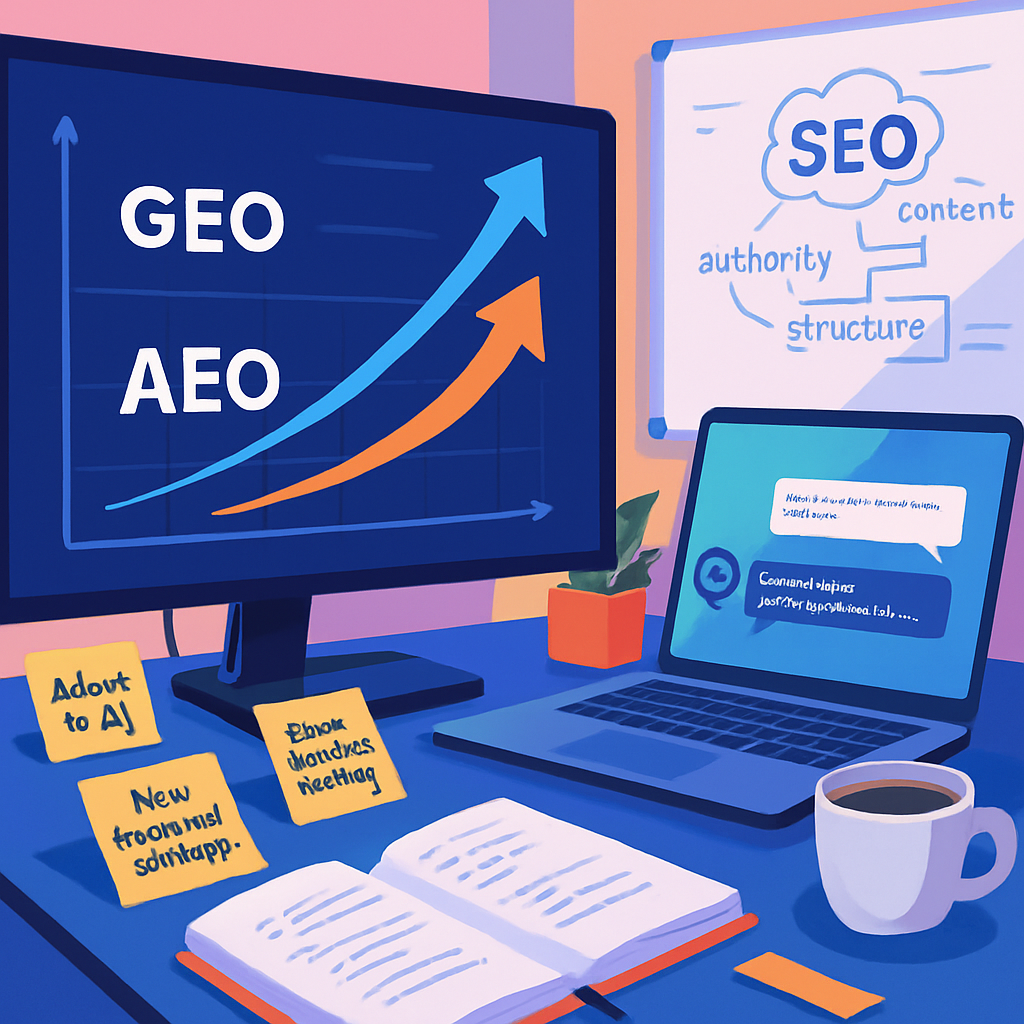
We are in the midst of a shift from classic, keyword-driven SEO to generative engine optimization (GEO) and answer engine optimization (AEO), where visibility depends on being the best, most trusted answer to real questions. It outlines what’s changing in search behavior, how AI and LLMs assemble answers, and why small teams can win by structuring content for AI readability, authority, and topic ownership.
Key Takeaways:
- GEO = optimizing your brand so AI assistants and answer engines use your content in their responses, not just list your site as a blue link.
- Answer engines favor content that is clearly structured, question-led, supported by schema, and backed by strong reputation signals (links, citations, reviews, author credentials).
- Search behavior is shifting from “type a keyword, scan links” to conversational “ask a question, get a synthesized answer,” often powered by AI Overviews and LLMs.
- Smaller teams can gain disproportionate visibility by becoming the most helpful, frequently updated source on tightly defined topics.
- GEO success requires new KPIs (AI visibility, citations, share of voice) alongside traditional rankings and organic traffic.
- Practical next steps include auditing content through an AI lens, tightening schema, aligning topics with real customer questions, and investing in digital PR and expert-driven content.
Search is in the middle of a generational shift.
For years, “doing SEO” meant optimizing for a familiar pattern: a user types a query into a search bar, scans a list of links, and clicks through to a website. That world still exists, but it’s no longer the only path to discovery, and soon it may not be the primary one.
Today, users are increasingly asking questions in chat-based interfaces and receiving direct answers assembled by large language models (LLMs) and AI systems. That’s where Generative Engine Optimization (GEO) and Answer Engine Optimization (AEO) come in.
This article explains what’s changing, what isn’t, and how teams can evolve their strategies to stay visible, not just in traditional search results, but inside LLMs, AI overviews, and answer engines.
From “Search Keywords” to “Answering Questions”
Classic SEO was largely built on an idea:
Match pages to keywords and earn a high ranking.
In the emerging GEO/AEO world, the model looks more like this:
Become the best, most trusted answer to a topic or question—across any platform where that question is asked.
Generative and answer engines (Google’s AI Overviews, ChatGPT, Perplexity, Gemini, etc.) build responses based on a combination of:
- Topical relevance
- Content clarity and structure
- Authoritativeness and reputation
- Machine readability and metadata
Instead of focusing purely on isolated keywords, marketers now need to think in terms of:
- Topics and question clusters
- Search plus “ask-and-answer” behavior
- How content is reused, cited, and summarized by machines
That doesn’t mean traditional SEO is dead—it means SEO is becoming the foundation for a broader discoverability strategy that includes LLMs and answer engines.
What’s Actually Changing?
Let’s break down the key shifts marketers and agencies should be paying attention to.
1. Search is becoming “ask and answer”
Users are no longer satisfied with a list of links. They expect:
- Direct, synthesized answers
- Context (pros/cons, comparisons, “what to do next”)
- Actionable recommendations
LLMs pull this from multiple sources at once. If your brand doesn’t have clear, structured, trusted content on a topic, you simply won’t be part of that synthesized answer.
2. Content structure and machine readability matter more
It’s not enough for content to be “good” in a human sense. It also needs to be:
- Structured with headings, lists, tables, and clear sections
- Supported with schema markup and structured data
- Written in a way that maps to real-world questions and intents
At Page One Web Solutions, for example, we’re revisiting existing content and creating new assets with AI readability as a requirement—not an afterthought.
3. Reputation and authority are core ranking signals
LLMs are heavily influenced by signals of trust and authority:
- Are you mentioned or cited by other reputable sources?
- Is your brand associated with helpful, accurate information?
- Do authors have visible credentials and a consistent digital footprint?
This is why reputation management and digital PR now sit alongside technical SEO and content strategy as part of a modern visibility playbook.
4. The content production model is evolving
The “old” model of content production—manual, slow, and campaign-by-campaign—is no longer competitive.
Modern teams are:
- Using AI to accelerate research, outlining, and drafting
- Layering human expertise on top to ensure accuracy, nuance, and brand fit
- Producing more content, more strategically, without linearly increasing costs
At our agency, we’ve adopted AI as a force multiplier, not a replacement for strategists, writers, or designers. The teams that refuse to adapt risk getting outpaced by those who embrace these tools responsibly.
Why This is a New Opportunity for Smaller Teams
One of the most encouraging aspects of this shift is that it levels the playing field.
Historically, smaller companies and agencies have used smart SEO and content strategies to compete with much bigger players. GEO and AEO extend that opportunity:
- Large organizations often move slowly.
- Smaller marketing teams and boutique firms can move quickly, structure their content correctly, and claim topic ownership early.
If you can become the most helpful, clearly-structured, and frequently-updated source on a focused set of topics, you have a genuine chance of winning visibility—not just on page one of Google, but inside AI answers delivered directly to your prospects.
What GEO Looks Like in Practice
So what does GEO-aligned work actually involve?
Here are some of the tangible initiatives modern agencies and marketing teams are rolling out (including ours) to gain visibility in LLMs and answer engines.
1. Structuring content for AI discoverability
Instead of “just publishing a blog post,” content is:
- Organized around clear, answerable questions
- Broken into logical sections with descriptive headings
- Paired with schema markup (FAQ schema, article schema, product schema, etc.)
This makes it easier for LLMs and search engines to:
- Parse the content
- Extract relevant snippets
- Cite that content in answers and overviews
2. Building and signaling authority
Agencies and in-house teams are investing in:
- Digital PR campaigns that earn coverage and backlinks
- Author profiles and E-E-A-T signals (Experience, Expertise, Authoritativeness, Trustworthiness)
- Consistent, long-form content that demonstrates real domain expertise
At Page One Web Solutions, we’re pairing classic link-building and PR with GEO-oriented goals: not just “get a backlink,” but “earn citations and mentions that LLMs will see as proof of authority.”
3. Designing answer-first content
Answer-first content is:
- Explicitly written to answer “how,” “what,” “why,” and “who” questions
- Structured with short, clear summaries, followed by deeper detail
- Crafted to bridge the gap between problem (the user’s situation) and solution (the product or service)
This isn’t about writing for robots; it’s about writing so clearly and helpfully that both humans and machines can recognize your content as the best answer.
4. Expanding KPIs beyond ranks and clicks
Rankings and organic traffic still matter. But in a GEO/AEO world, they’re only part of the picture.
Forward-thinking teams are tracking things like:
- AI visibility (how often the brand appears in AI-generated responses)
- Share of voice across key topics
- Brand sentiment and reputation trends
- Citation incidence (how often content is referenced by third parties)
At our agency, we’re building balanced performance dashboards that mix traditional SEO metrics with emerging GEO/AEO signals, so clients see how their visibility is evolving across both search results and AI environments.
Practical Next Steps for Marketers and Small Agencies
If you’re responsible for digital strategy—whether for your own business or for clients—here are some concrete steps to consider:
- Audit your content through an AI lens
- Which pages clearly answer specific questions?
- Where are there gaps in core topics your audience cares about?
- Are your highest-value assets structured in a way that’s easy to parse and cite?
- Implement or refine schema and structured data
- Start with key pages: services, products, cornerstone content, FAQ resources.
- Use schema types that match your content (e.g., Article, Product, FAQ, LocalBusiness).
- Align content topics with real customer questions
- Pull language from sales calls, chats, support tickets, and RFQs.
- Turn those into question-led content sections and FAQs.
- Invest in reputation and authority, not just ranking
- Treat digital PR, thought leadership, and reviews as essential inputs to visibility.
- Highlight real experts with strong author bios and consistent publishing.
- Test and adapt with AI tools in your workflow
-
- Use LLMs for ideation, outline generation, and early drafting.
- Maintain human oversight for strategy, messaging, and quality control.
-
The Bottom Line
GEO and AEO do not erase the last 20 years of SEO—they build on them.
- Technical SEO still matters.
- Content quality still matters.
- Links and reputation still matter.
The shift is in where and how visibility is measured. It now extends beyond search engine results pages into LLMs, AI assistants, and answer engines that will increasingly mediate how users discover brands, evaluate options, and make decisions.
For marketers and small agencies, this is both a challenge and an opportunity:
- A challenge, because the landscape is evolving quickly.
- An opportunity, because the teams that move early—and structure their strategies around topics, questions, authority, and AI readability—can punch far above their weight.
If you’re exploring how to evolve your own approach to include GEO and AEO, look at your current SEO, content, and PR efforts and ask:
“How do we turn this into an answer engine strategy, not just a search engine strategy?”
That’s the mindset shift that will matter most in the years ahead.

At Page One Web Solutions, we’ve evolved our SEO, content, and PR services to include a full GEO and AEO strategy—helping clients earn visibility not just in search results, but inside AI-driven answers. As a data-driven digital agency specializing in SEO, PPC, and web design, based in Portland, Maine, we partner with growth-focused brands to audit their content for AI readiness, implement structured data, and build the authority signals that answer engines look for.
Frequently Asked Questions
What’s the difference between SEO and GEO?
SEO focuses on helping your pages rank in traditional search engine results. GEO (Generative Engine Optimization) focuses on getting your brand cited and quoted inside AI-generated answers from tools like Google’s AI Overviews, ChatGPT, Perplexity, and Gemini.
In practice, GEO builds on SEO but puts extra emphasis on question-led structure, schema, and authority signals that LLMs can easily parse.
How do I optimize my content for answer engines and LLMs?
Start by organizing each piece around specific questions (“what is,” “how to,” “why,” “who”) and answering them clearly in the first few sentences. Use headings, bullet lists, short paragraphs, and FAQ sections so AI systems can extract clean snippets. Then add schema (Article, FAQPage, Product, LocalBusiness) and make sure your brand is earning mentions, reviews, and links from reputable sites.
How can small marketing teams compete with big brands in GEO?
Smaller teams can move faster: you can pick a focused cluster of topics, publish the clearest content on those topics, and update it frequently. Because many large organizations are slow to adapt, a boutique agency or lean in-house team that structures content well and invests in authority (PR, reviews, thought leadership) can become the “default” answer source on narrow but valuable topics.
What KPIs should we track for GEO and AEO?
- Layer GEO metrics on top of classic SEO KPIs. Track things like:
- How often your brand is mentioned or cited in AI answers across tools
- Share of voice on key topics in both SERPs and AI environments
- Growth in branded search and direct traffic after GEO initiatives
- Changes in reviews, digital PR coverage, and high-quality backlinks
You can also log where your content appears in AI Overviews and LLM responses over time.
Where should I start if we already have an SEO program?
Begin with an “AI readability” audit of your existing content. Identify 5–10 core pages (services, cornerstone blogs, FAQs) and:
- Rewrite intros to answer top questions directly
- Restructure content with clear headings and bullets
- Add or refine schema