

Holiday emails can strengthen or sabotage your email deliverability and future campaign performance. Inbox providers like Google and Yahoo have certain expectations; engagement is essential, and marketers need to craft festive messages that actually help their sender reputation. When sending holiday marketing emails, they should continue to be strategic, meaningful, and measurable - just like every other email campaign.
As a marketer, you're committed to building relationships, spreading joy, and showing off a touch of Canva-templated magic. Of course, you’re planning to send a holiday greeting email. After all, what better way to connect with your audience than by delivering a little festive cheer straight to their inbox? It’s practically the digital equivalent of leaving out milk and cookies for Inbox Santa.
But beware… if your holiday email isn’t done right, you might get a visit from the Krampus of email deliverability instead. And spoiler alert: he doesn't just target the bad email marketers; he takes your sender reputation down with them.
Let’s talk about how to avoid being haunted by the ghosts of emails past and instead build a campaign that spreads holiday joy and keeps you on the nice list with Google, Yahoo, and all your subscribers.
❄️ Yes, Virginia, There IS a Correct Way to Build Holiday Emails
As a brand, we get it: it’s tempting to slap a “Happy Holidays!” in a subject line, paste in a cute GIF, and hit send. But if you want that email to actually land in the inbox (and not the junk folder), it needs a bit more sparkle.
Recent changes from email giants like Google and Yahoo (the infamous Yahoogle update) are putting engagement front and center. These platforms are watching your:
- Open rates (Is your subject line worth unwrapping?) Solid open rates often sit above ~30–40% across industries. But open rates in the high teens to low 20s are the minimum to strive for.
- Click-through rates (is there something compelling inside?) Neither Gmail nor Yahoo publishes exact “required open” or “required click” rates - engagement thresholds aren’t rigid numbers you have to hit - but providers absolutely do use open and click behavior as signals that a subscriber wants your email. Click rates of 2-3% or Click-through rates of 7-10% are a reasonable minimum to aim for.
- Spam reports (did someone hit “Bah Humbug” on your message?) Gmail and Yahoo require a spam complaint rate under 0.3% - that’s no more than three complaints per every 1,000 emails delivered. Industry experts strongly recommend keeping this well below 0.1% to maintain optimal long‑term deliverability health.
- Unsubscribe rates (are you the holiday sweater they can’t wait to ditch?) While Google and Yahoo haven’t published specific thresholds, broader email marketing benchmarks suggest that unsubscribe rates ideally stay ~0.5% (anything higher is a sign of poor relevance to your audience and can correlate with filtering issues).
Holiday emails with no click-worthy content or clear purpose are practically coal in your audience’s inbox. If you're not giving them something they want to engage with, your message may be silently buried by inbox algorithms that assume you’re irrelevant, or worse: spammy.
🎁 Don’t Be a Scrooge: Create Something Worth Clicking
If you’ve already achieved strong email engagement…congratulations! A holiday message can be a warm, fuzzy, relationship-building moment. Even if it doesn’t achieve sky-high click rates, your prior history gives you a little leeway with the inbox gatekeepers.
But if your email metrics are more “lump of coal” than “shiny ornament,” it’s time to be strategic.
Instead of just saying “Happy Holidays,” create something that actually drives interaction:
- 🎄 A virtual card that your audience clicks to view
- 📹 A holiday video from your team (bonus points for awkward sweaters) hosted on a landing page they have to click out to
- ✨ A blog post recapping your year or sharing holiday tips
- 🎁 A discount, promotion, or exclusive offer for the season
If none of that fits your business model, share valuable content that supports your customers, such as a sneak peek at how you’ll help them in the new year or a roundup of your most helpful articles, tools, or case studies.
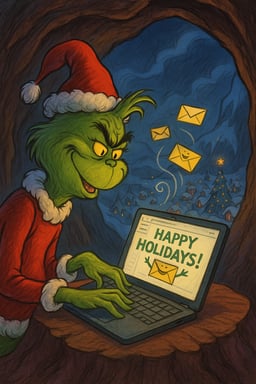
The key is to give your audience something to click, read, or interact with (or risk the engagement Grinch stealing your deliverability).
📉 Silent Night, Inbox Fight: When Holiday Emails Hurt
Sending a holiday message with no strong CTA, no relevant content, and no forethought? That’s not spreading cheer, that’s gambling with your reputation.
Here’s why that matters:
If a poorly engaged holiday email drags your metrics down, you don’t just risk that email landing in spam. You can tank future performance, too. Your January campaigns (the ones that do matter for your pipeline) could suffer thanks to the ghost of a lonely December send.
Remember: email platforms don’t evaluate your emails in isolation. They evaluate you as a sender. So when you send fluff, you're essentially telling the inbox elves, “Eh, don’t bother delivering this one.”
 🔔 All I Want for Christmas is... Strategy
Holiday emails aren’t inherently bad. In fact, they can be one of the best ways to reinforce your brand and foster warm, memorable connections, if they align with your broader strategy.
Ask yourself:
- Does this message reinforce our relationship with our audience?
- Does it drive any engagement that helps us in the long term?
- Is there a clear CTA or value exchange?
If the answer to all three is no, it’s time to rethink your approach. A well-planned message can build trust and make your subscribers smile. A thoughtless one might make them reach for the unsubscribe link while muttering, “Bah humbug.”
🎉 Make It Merry and Measurable
You don’t have to cancel your holiday email plans…far from it! But you do need to make them count. Whether you’re sending seasonal cheer, exclusive content, or a promotion wrapped in a bow, every email you send should:
- Support your overall email marketing goals
- Drive meaningful engagement
- Preserve (or boost!) your deliverability.
It’s not about being a grinch. It’s about being smart. Holiday emails can be a beautiful thing — but only if they bring more than just tinsel and sentiment. Give your subscribers something they want, and you’ll be unwrapping higher open rates, better clicks, and stronger customer relationships all year long.
So go ahead, light up those inboxes. Just make sure you’ve got a strategy behind that sparkle.

At Page One Web Solutions, we help marketing teams strengthen email performance through more innovative strategies, audience insights, and data-driven optimization. If you're looking to improve deliverability, refine your email content, or build campaigns that consistently drive engagement, the Page One Team can support you with diagnostics, strategic guidance, and ongoing optimization programs. Learn more about our email performance services or request a deliverability review today.
Frequently Asked Questions
1. Do holiday emails really impact long-term email deliverability?
Yes—holiday emails can significantly influence your sender reputation. If a seasonal message performs poorly (low opens, low clicks, high spam complaints), inbox providers may downgrade your future campaigns, including your high-value January sends.
2. What’s the minimum engagement I should aim for in my holiday email?
Aim for open rates around 30–40% (or at least high teens to low 20s) and click rates between 2–3%. These aren’t strict requirements, but they signal to inbox providers that subscribers actually want your content.
3. Should I send a holiday email even if I don’t have a promotion?
Absolutely—as long as you provide something meaningful to click or engage with. Think a virtual card, a short team video, an end-of-year recap, or a curated resource list that helps maintain healthy engagement.
4. Can one bad email really affect my deliverability?
Unfortunately, yes. Inbox providers evaluate performance at the sender level, not just the email level. A single low-engagement send can weigh down your overall reputation, especially during peak filtering periods like December.
5. How do I know if my subscribers actually want a holiday message?
Look at your historical engagement patterns. If recipients consistently open and click your content, a holiday email is usually welcomed. If engagement is weak, be more strategic—offer value, personalize the message, or segment your list before sending.