
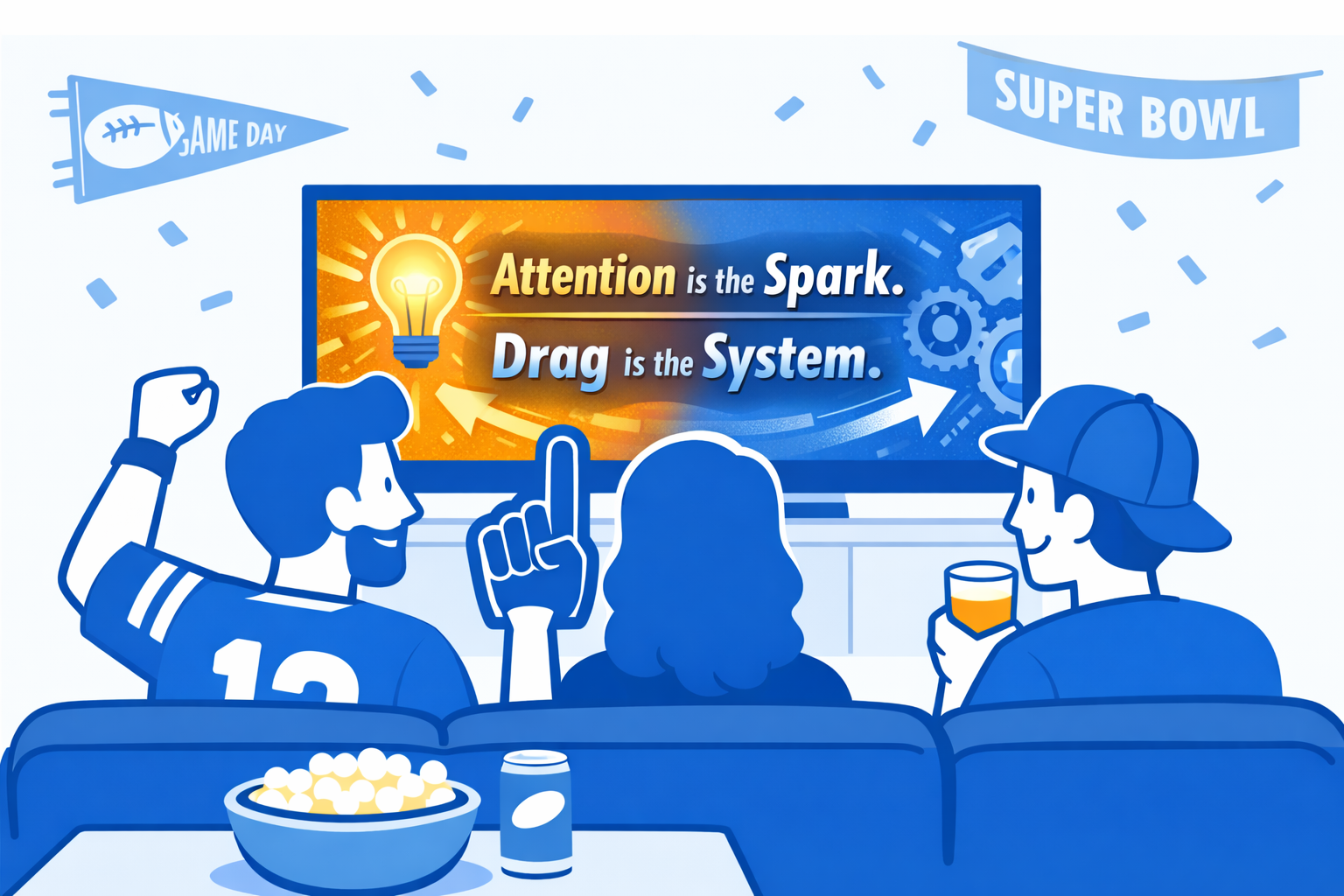
Most B2B teams treat attention like the win—launch the campaign, celebrate the spike, move on. But attention is rented, not owned. The real cost (and real opportunity) of marketing starts after someone notices you. Just like Super Bowl advertisers, high-performing B2B teams design for drag: the systems that pull prospects forward through nurturing, retargeting, and timely sales follow-up. When momentum dies, it’s not an awareness problem—it’s a drag problem.
This morning, I was listening to an episode of the Best One Yet podcast with Nick and Jack when something jumped out at me.
They were breaking down the real cost of a Super Bowl commercial, after Ro’s CEO publicly shared his full budget. Not just the headline number everyone likes to quote—but the actual strategy behind it.
Yes, the 30-second spot cost millions.
But that wasn’t the point.
The point was how much of the total investment was allocated to drag, as Nick & Jack would call it.
Not drag as in delay.
Drag as in dragging the audience forward after the ad airs.
And that’s where most B2B marketing quietly falls apart.
The Lie We Tell Ourselves in B2B Marketing
In B2B, we love the first moment:
- The launch
- The campaign
- The webinar
- The “big” piece of content
We treat attention like the finish line.
It isn’t.
Super Bowl advertisers understand something B2B teams often ignore:
Attention without follow-through is just expensive noise.
No brand drops eight figures on a commercial and then shrugs when the game ends. They assume—correctly—that the real work starts after the spotlight hits.
Drag Is the Strategy, Not the Side Effect
Super Bowl campaigns are engineered around drag:
- Follow-up creative
- Retargeting everywhere
- Social amplification
- PR extensions
- Purpose-built landing experiences
The ad is just the spark.
The drag is what turns interest into action.
In B2B, drag exists whether you design it or not. The difference is whether it pulls prospects forward—or lets them drift away quietly.
Drag Layer One: Nurture or Lose Them
Most B2B nurturing is defensive.
It tries not to annoy.
That’s the problem.
Effective nurturing should advance the conversation, not preserve it in amber. If your emails, content, and follow-ups don’t move the buyer closer to a decision, you’re not nurturing—you’re stalling.
If someone raises their hand, downloads something, or shows interest, and your response doesn’t deepen the narrative, you’ve already lost momentum.
That’s not respectful.
That’s careless.
Drag Layer Two: Retargeting That Reminds Them Why They Cared
Retargeting isn’t about being everywhere.
It’s about being relevant after the moment passes.
Super Bowl brands don’t retarget to say, “Remember our logo?”
They retarget to reinforce the story, the feeling, the promise.
B2B retargeting should do the same:
- Clarify the problem
- Show proof
- Reduce perceived risk
- Reframe the stakes
If your retargeting just repeats your offer, you’re wasting impressions.
Drag only works when it moves the story forward.
Drag Layer Three: Sales Follow-Up That Doesn’t Kill Momentum
This is where most funnels quietly die.
Marketing generates interest.
Signals show intent.
And sales show up late, generic, or not at all.
Meanwhile, Super Bowl advertisers would never wait days or weeks to capitalize on peak attention.
In B2B, speed and relevance aren’t aggressive—they’re competent.
A timely, human follow-up doesn’t feel like pressure.
It feels like continuity.
And continuity is what drag is actually about.
The Uncomfortable Truth
The Super Bowl isn’t successful because of a single commercial.
It’s successful because brands refuse to let attention evaporate.
They design for what comes next.
If your B2B marketing is strong at generating interest but weak at pulling people forward, the problem isn’t awareness.
It’s drag.
And until you start treating post-attention strategy as the core of your funnel—not an afterthought—you’ll keep wondering why “great campaigns” don’t turn into revenue.
Because attention is rented.
Momentum is built.
And drag is where B2B marketing either proves it works—or quietly fails.
Actionable Drag: Turning Insight into Implementation
The question isn't whether you have a Drag Factor—it's whether you control it.
If your B2B organization is ready to move beyond "expensive noise" and design a post-attention strategy that actually builds momentum, here are two clear paths forward:
-
For a Full Drag Audit & Strategy Implementation:
Page One Web Solutions specializes in engineering B2B funnels for continuity. We don't just generate the spark; we design the entire system (the Drag) that converts interest into sustainable revenue. -
For Tooling Your Drag Engine:
Is your current tech stack letting momentum die? HubSpot is the ideal platform for building the timely, relevant, nurturing, and sales follow-up strategies discussed here. Use their automation and CRM tools to ensure zero drag leakage.
Stop letting your best marketing investments evaporate. Start designing for what comes next.

Frequently Asked Questions (FAQs)
What does “drag” actually mean in a B2B marketing context?
Drag is everything that happens after you get attention. It’s the intentional effort—nurture, retargeting, sales follow-up, and experience design—that moves a prospect from interest to action. Without drag, attention fades and campaigns quietly underperform.
Why do strong B2B campaigns fail to turn into revenue?
Because most teams stop at the spark. They invest heavily in generating interest but underinvest in what comes next. When follow-up is slow, generic, or disconnected, momentum evaporates—even if the campaign itself was “successful.”
Isn’t too much follow-up annoying for B2B buyers?
Irrelevant follow-up is annoying. Timely, contextual follow-up feels competent. Buyers don’t disengage because you showed up—they disengage because you showed up late, empty-handed, or without continuity.
How can B2B teams improve their Drag Factor without increasing ad spend?
By reallocating effort, not just budget. Improve nurture sequences that advance the narrative, use retargeting to reinforce why buyers cared, and tighten sales response times. Drag is a systems problem—not a spend problem.